

Key takeaways
- check_circleThe differences between verifiers show up on the addresses they cannot confirm, not the ones they can. Anyone can identify a working mailbox and a dead domain.
- check_circleAround one in five B2B domains is catch-all, meaning it accepts mail to every address. No verifier can confirm a specific mailbox there, and how a tool reports that is the single most useful thing to compare.
- check_circleMailsfinder, Bouncer and Kickbox report catch-all as its own status. Tools that fold it into valid will flatter your list and raise your bounce rate.
- check_circleBouncer does not charge for unknown results or duplicates, which is a real discount on a messy list rather than a marketing line.
- check_circleZeroBounce has the deepest review base here at 1,361 G2 reviews and the widest feature set, including inbox placement and blacklist monitoring, at the highest price per check.
- check_circleReoon holds the highest verified rating in the category at 4.8 across 1,018 reviews, and gives 600 free credits a month with API access.
- check_circlePublished accuracy claims cluster at 97 to 99 percent and none were measured on the same list, so treat them as marketing until you run your own sample.
- check_circleCost per 1,000 checks runs from roughly $0.08 to $19.50 across these tools. The full arithmetic is on our verification pricing comparison, linked below.
What an email verifier actually checks
A verifier runs an address through a series of tests and returns a verdict. Syntax first, which catches typos. Then the domain: does it exist, and does it publish an MX record saying where its mail should go. Then, for most tools, a live SMTP conversation with that mail server, asking whether it would accept mail for this specific mailbox without actually sending anything.
That last step is where the useful signal lives, and where tools diverge. A verifier that only checks syntax and domain will happily pass every address at a live domain, including the ones that bounce. A verifier that opens an SMTP conversation gets an answer from the server itself, which is why the results reflect reality today rather than whatever was true when a database was last refreshed.
The complication is the catch-all domain, sometimes called accept-all. A catch-all server is configured to accept mail addressed to anything at that domain and sort it out later, so asking it about a specific mailbox tells you nothing. Around a fifth of B2B domains behave this way. Every verifier hits the same wall here, and the honest ones say so with a distinct status rather than guessing.
That is the comparison that matters. A tool reporting catch-all as valid will hand you a list that looks cleaner and bounces harder. A tool reporting it as invalid will make you throw away addresses that are probably fine. A tool giving it its own status lets you decide, which usually means sending to those addresses on a separate, slower schedule and watching what happens.
The tools at a glance
How we evaluated these tools
These tools were judged on what they do with ambiguous addresses, not on whose accuracy claim is largest. Pricing and ratings come from the research data, re-verified against vendor pricing pages in September 2026. Where a vendor publishes no figure, the tables say so rather than carrying an estimate.
How catch-all is reported
Its own status, folded into valid, or folded into invalid. This decides your bounce rate more than anything else.
Live SMTP check or database lookup
A live check reflects the mail server today. A stored record reflects whenever it was last refreshed.
What the guarantee covers
Bounce guarantees and credit refunds vary widely, and several tools offer none at all.
Integrations and API depth
Whether verification fits into the tools you already run, or becomes another manual upload.
Three kinds of verifier, and what each is really for
The category looks uniform from the outside. These three groups behave quite differently in practice.
Dedicated bulk verifiers
MillionVerifier, EmailListVerify, DeBounce and Bouncer do one job at low unit cost. Buy credits, upload a list, get a scored file back. Best when cleaning is a periodic task rather than a live requirement.
Deliverability suites
ZeroBounce and Kickbox wrap verification in inbox placement testing, blacklist monitoring and deliverability scoring. You pay considerably more per check and the extra tooling is the point.
Verifiers attached to a finder
Mailsfinder and Hunter verify from the same account that finds addresses. One vendor, one balance, and the verification is priced as part of a wider product rather than sold alone.
Every tool, side by side
Rank is a table position, not a promotional order.
| Tool | Type | Catch-all handling | Cost per 1,000 | Free tier | Rating |
|---|---|---|---|---|---|
| Mailsfinder | Finder plus verifier | Own status | ~$0.1 | 100 a day | New on G2 |
| ZeroBounce | Deliverability suite | Scored | ~$19.50 | 100 a month | 4.7/5 (1,361) |
| Reoon | Dedicated verifier | Reported | ~$1.19 | 600 a month | 4.8/5 (1,018) |
| MillionVerifier | Dedicated verifier | Reported | ~$1.78 | Trial credits | 4.3/5 (28) |
| Bouncer | Dedicated verifier | Own status | ~$4.00 | 100 credits | Not in our verified data |
| Kickbox | Deliverability suite | Own status | ~$8.00 | 100 credits | Not in our verified data |
| Emailable | Dedicated verifier | Scored | ~$4.90 | 250 credits | Not in our verified data |
| Clearout | Dedicated verifier | Reported | ~$6.50 | 100 for life | Not in our verified data |
| EmailListVerify | Dedicated verifier | Reported | ~$1.86 | 100 credits | Not in our verified data |
| DeBounce | Dedicated verifier | Charged 10x | ~$0.45 | 100 credits | Not in our verified data |
| Hunter | Finder plus verifier | Scored | ~$4.60 | 50 a month | 4.4/5 (634) |
| NeverBounce | Dedicated verifier | Reported | Not published | Not verifiable | Not in our verified data |
Ratings shown only where our research data carries a verified figure and review count. Rates read from vendor pricing pages in September 2026; the full arithmetic is on our verification pricing comparison. Order is a table position, not a ranking. Cost per unit uses each vendor's best published rate, which is usually a larger pack or plan than the entry price in the column beside it, so the two do not divide into each other.
Cost calculator
What cleaning your list costs
Rates use each vendor's published price at a mid-volume tier. DeBounce uses its published floor and will be higher at small volumes. NeverBounce is excluded because it publishes no figure a client can read.
| Tool | Addresses you can check | Rate used |
|---|
Rates read from vendor pricing pages in September 2026. Your real cost moves with your catch-all share and the tier you qualify for at checkout.
The tools, reviewed
Every tool gets the same card: what it is, four features, three pros, three cons, and an honest read. Same format for ours as for everyone else's.
Mailsfinder
Live SMTP check, catch-all flagged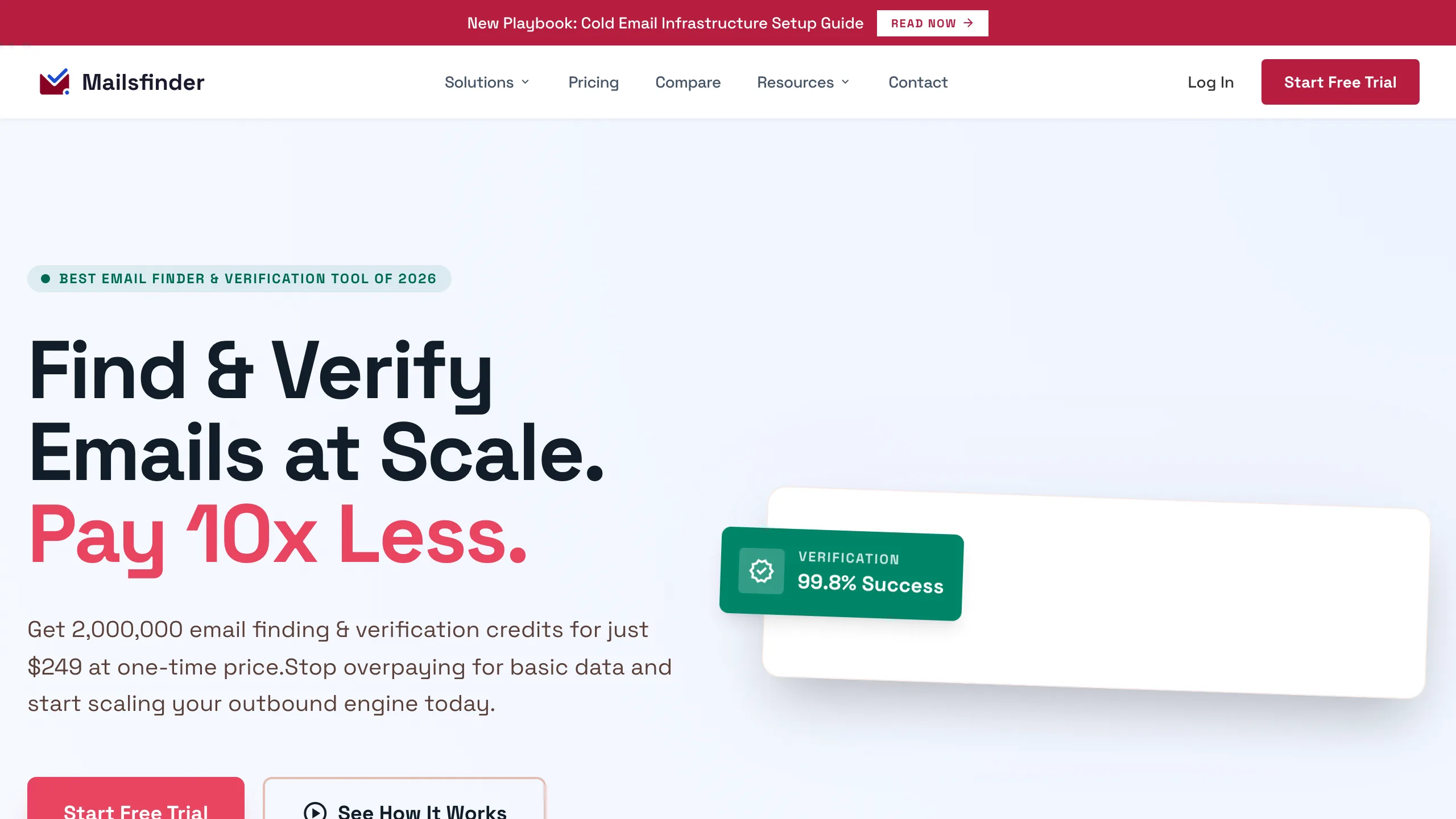
Ours, so read the cons first and check the numbers yourself. Verification opens a live SMTP conversation with the recipient's mail server rather than reading a stored record, and reports a catch-all domain as its own status instead of folding it into valid. Upload a CSV, XLSX or Google Sheet and the file comes back split into deliverable, undeliverable, catch-all and risky. One credit per verification, three per found address, out of the same pool, with daily verification caps of 3,000 on Starter through 20,000 on Agency.
Key features
- checkLive SMTP check per address the verdict reflects the mail server now, not a cached record.
- checkCatch-all as its own status not folded into valid, so you decide what to do with those rows.
- checkFinding from the same balance 1 credit to verify, 3 to find, charged only on a hit.
- checkFree catch-all checker a public tool that shows whether a whole domain accepts everything.
Pros
- addCatch-all reported honestly, not guessed
- addLowest cost per check on this page
- addFree tier renews daily, no card
Cons
- removeNo API below the $19.99 Growth plan
- removeMonthly credits do not roll over
- removeNewer platform with a thin review record
The honest read
Strong on the ambiguous addresses and on price. What it lacks is the deliverability tooling of the suites and the public review history of the incumbents.
ZeroBounce
Deliverability suite, deepest review base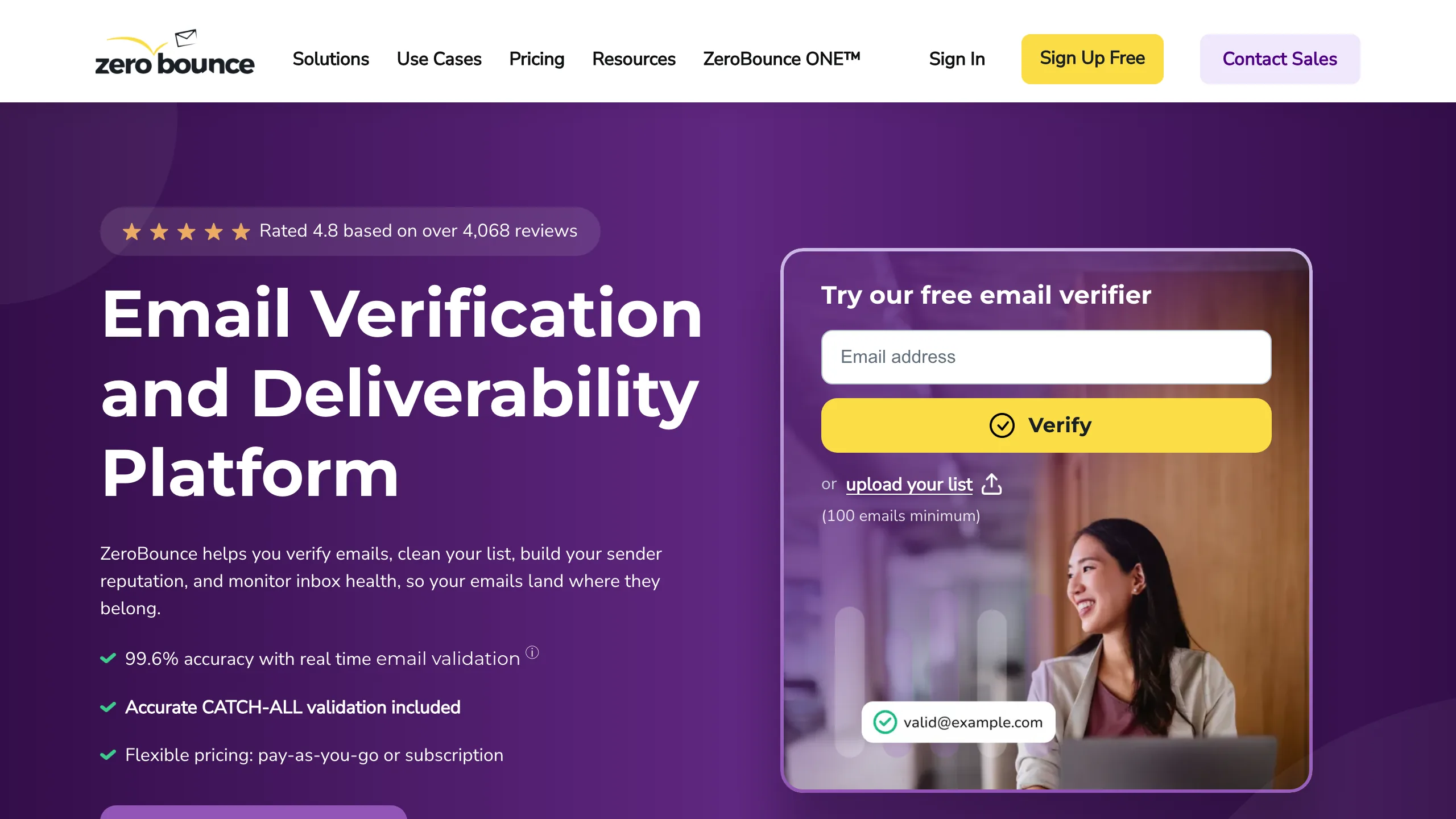
With 1,361 G2 reviews at 4.7 this is the most reviewed tool in the category, and the product is considerably wider than verification: inbox placement testing, blacklist monitoring, DMARC monitoring, warmup seeds and an activity-data signal that estimates whether an address has been active recently. That last feature is genuinely differentiated. The cost is the highest here, with a published pay-as-you-go minimum of $39 for 2,000 credits, and the ONE subscription from $99 a month for 10,000 credits that roll over.
Key features
- checkActivity data on addresses an estimate of recent engagement, rare in this category.
- checkInbox placement and blacklist monitoring deliverability tooling beyond list cleaning.
- checkCredits roll over on ONE one of the few subscriptions that does not reset them.
- check1,361 G2 reviews at 4.7 the deepest verified base in this comparison.
Pros
- addWidest feature set in the category
- addMost reviewed tool here by a distance
- addSubscription credits roll over
Cons
- removeHighest published entry rate at $19.50 per 1,000
- removeFinder costs 20 credits per search, billed apart
- removeSuite is wasted spend if you only clean lists
The honest read
Buy it for the deliverability suite, not the verification. Judged on cost per check alone it is the most expensive option in this comparison by a wide margin.
Reoon
Highest rated, best free tier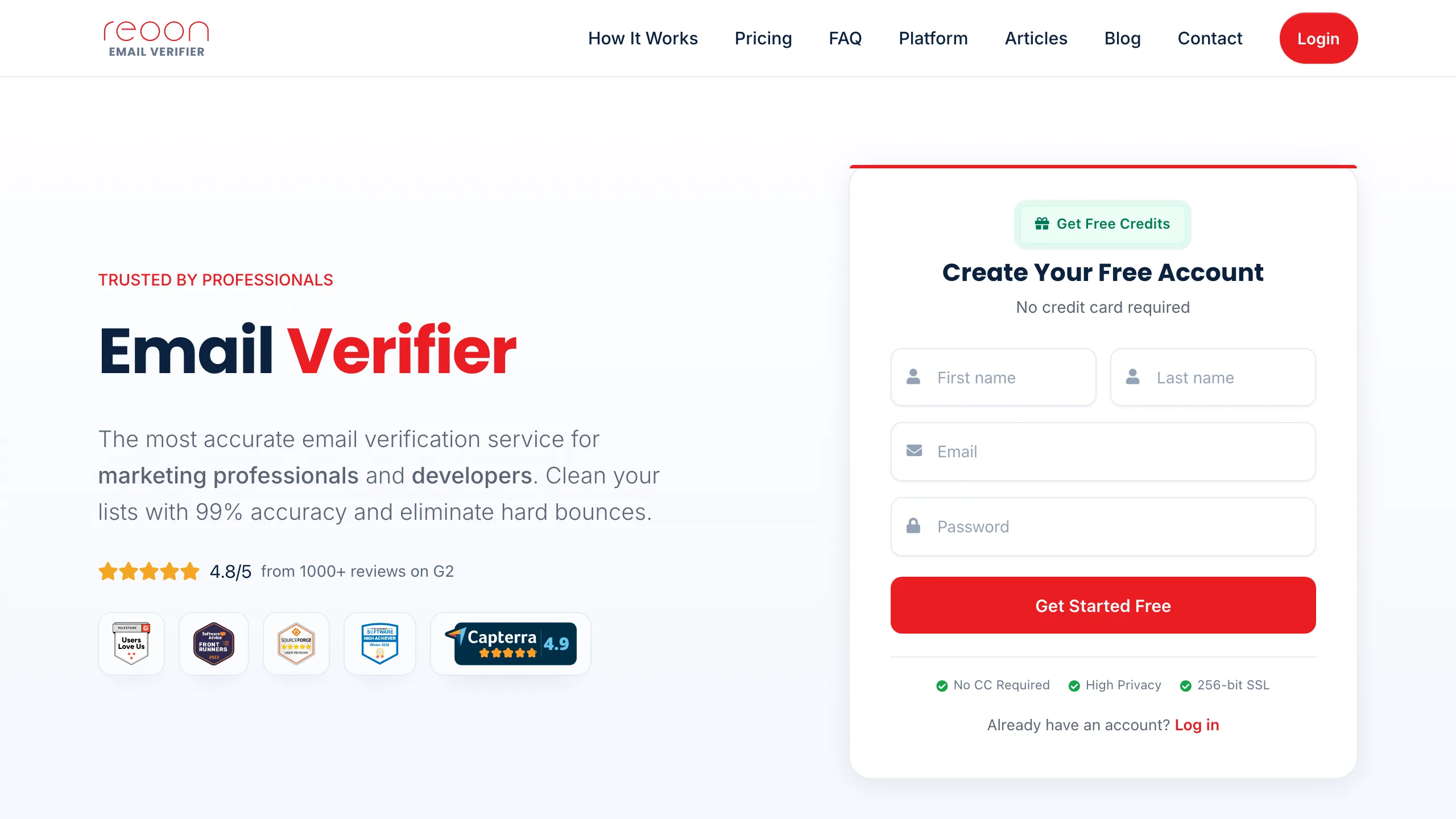
The highest verified rating in this comparison, 4.8 across 1,018 G2 reviews, paired with the most usable free tier: 600 credits a month that refill daily, with live API access included, which almost no competitor offers without payment. Paid credits are one-time purchases that never expire, $11.90 for 10,000 and $29.66 for 25,000. There are two verification modes, a quick check and a deeper one that takes longer per address and resolves more of the ambiguous cases.
Key features
- check600 free credits a month refilled daily, no card, API included.
- checkTwo verification modes a fast pass and a deeper check for ambiguous addresses.
- checkCredits never expire one-time purchases rather than a subscription.
- check1,018 G2 reviews at 4.8 the highest verified rating in the category.
Pros
- addBest free tier in this comparison
- addAPI access without paying anything
- addHighest verified rating here
Cons
- removeVerification only, no finder
- removeAround $1.19 per 1,000, above the bundled tools
- removeLighter enterprise tooling than the suites
The honest read
The one to start with when testing, because the free tier is large enough to be a genuine trial. At volume it is mid-priced rather than cheap.
MillionVerifier
Built for bulk files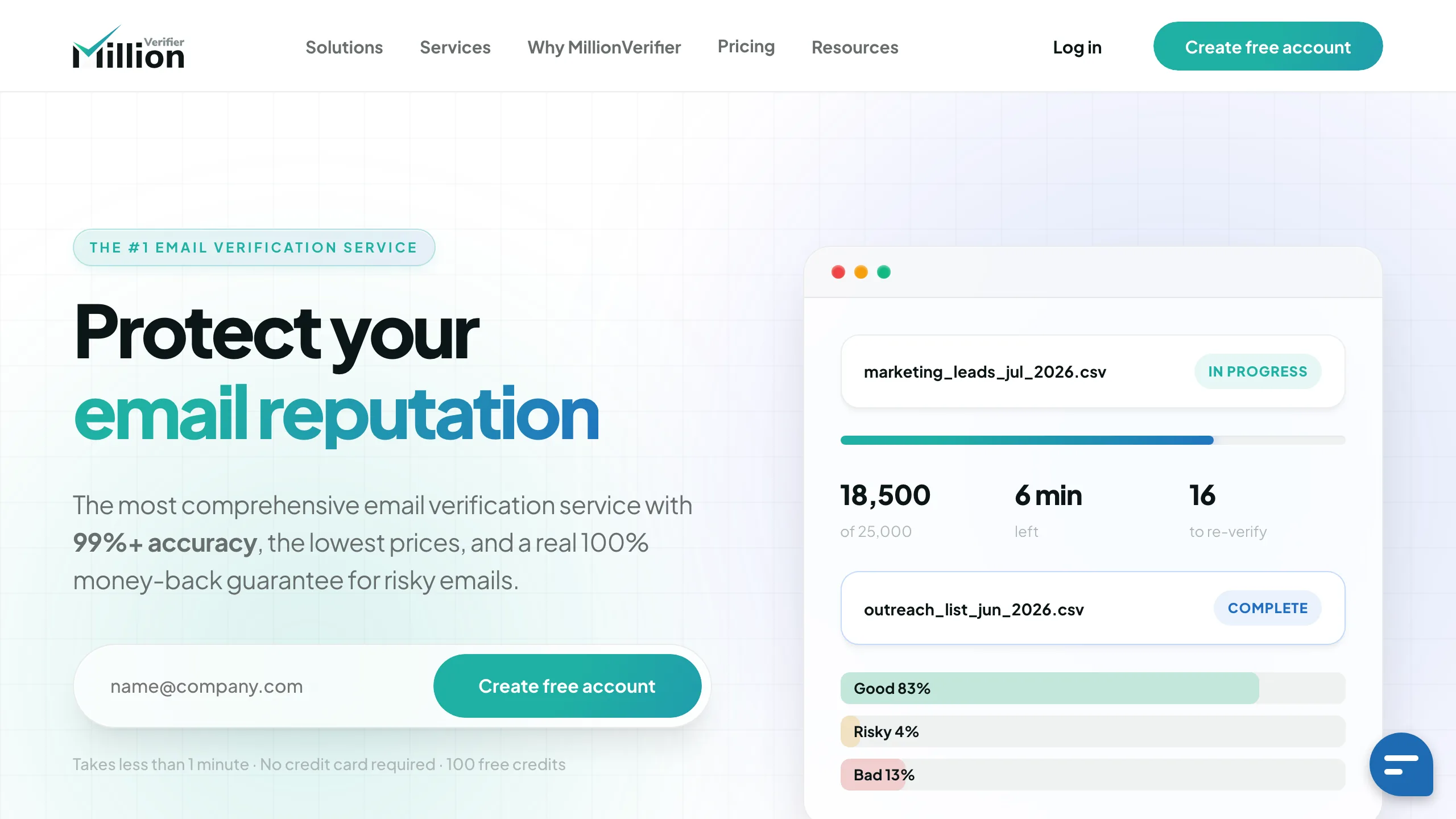
Large files are the entire design brief here, and it shows in both the interface and the pricing: $39 for 10,000 credits, $59 for 25,000, $89 for 50,000. The separate automated plan prices by daily throughput rather than credits, from $15 a month for up to 10,000 addresses a day, which is unusually good value for anyone verifying continuously. G2 coverage is thin at 28 reviews, though the 4.3 rating is solid and the tool has a long reputation among cold email operators who clean lists weekly.
Key features
- checkCredit packs from $39 falling to roughly $1.78 per 1,000 at the 50,000 tier.
- checkDaily-throughput plans from $15 a month for up to 10,000 addresses a day.
- checkDesigned around large files bulk handling is the core product, not an add-on.
- check4.3 on G2 across 28 reviews small sample, consistent score.
Pros
- addGood rate without needing huge volume
- addDaily plans suit continuous verification
- addLong track record on bulk lists
Cons
- removeOnly 28 G2 reviews to judge by
- removeVerification only, no finder
- removeInterface dated next to newer rivals
The honest read
The dependable mid-market choice, unlikely to delight or disappoint. The daily-throughput plan is the underrated option if your verification is continuous rather than periodic.
Bouncer
Fairest billing, GDPR-focused
Two billing policies here do more work than the rate does. You are not charged for duplicate addresses, and you are not charged for results that come back unknown, which on a list with a meaningful catch-all share is a genuine discount rather than a marketing line. Credits never expire. The published ladder runs from $8 for 1,000 down to $2,000 for a million, and the European base and GDPR posture put it on most EU shortlists. A Toxicity Check add-on flags spam traps and abusive addresses.
Key features
- checkNo charge for unknown results you pay for answers, not attempts.
- checkNo charge for duplicates deduplication happens before billing.
- checkToxicity Check flags spam traps and abuse addresses as a separate signal.
- checkCredits never expire packs bought outright, no subscription required.
Pros
- addFairest billing policy in this comparison
- addCredits never expire
- addStrong GDPR and EU positioning
Cons
- removeAround $4.00 per 1,000 at 100,000
- removeNot in our verified review data
- remove1,000 credit minimum purchase
The honest read
A mid-to-high rate attached to the most honest billing here. On a dirty list the unknowns-are-free policy closes much of the gap to a cheaper vendor.
Kickbox
Conservative verdicts, Sendex score
What sets Kickbox apart is the Sendex score returned with every check, a deliverability signal from zero to one that goes beyond a binary verdict and lets you set your own risk threshold rather than accepting the vendor's. Verdicts lean conservative, which means fewer false positives and more addresses parked as risky, a trade most teams protecting an established sending domain will take. Pricing is the simplest here and among the highest: a flat $0.010 an email to 2,500 credits, easing to $0.008 at 5,000.
Key features
- checkSendex deliverability score a graded signal on every result, not just a verdict.
- checkConservative verdicts by design fewer false positives, more flagged as risky.
- checkFlat $0.010 an email to 2,500 no tier maths and no commitment.
- check100 free verifications no monthly or annual commitment required.
Pros
- addGraded score lets you set your own threshold
- addSimplest pricing to budget against
- addReputation for accuracy over optimism
Cons
- remove$8.00 to $10.00 per 1,000, second highest here
- removeNo meaningful volume discount published
- removeVerification only, no finder
The honest read
You pay a clear premium for caution and simplicity. Defensible when a domain's reputation is worth more than the bill, hard to justify on a large list.
Emailable
Developer-first, scored results
The API reference sits next to the pricing page, which tells you who this is built for. Results carry a numeric score alongside the state, so you can set your own tolerance rather than accepting a binary verdict, and a real-time endpoint handles inline checks at signup. Both pricing models run side by side with the monthly one consistently about 15 percent cheaper: 5,000 credits cost $38 pay-as-you-go or $32.30 a month, and 50,000 cost $245 against $208.25.
Key features
- checkNumeric score with every result beyond a binary valid or invalid verdict.
- checkReal-time API for inline checks verification at the point of signup.
- checkPAYG and monthly published together the monthly rate runs about 15 percent lower.
- check250 free credits on signup enough for a genuine sample.
Pros
- addStrong developer documentation
- addScore allows your own risk threshold
- addBoth pricing models published clearly
Cons
- removeAround $7.60 per 1,000 at the 5,000 tier
- removeNot in our verified review data
- removeVerification only, no finder
The honest read
A well-built product at an unremarkable price. The score is the reason to choose it over a cheaper bulk verifier, if you will actually use it.
Clearout
Steep annual discount, real-time API
Monthly pricing is unremarkable at $19.50 for 3,000 credits and $40 for 10,000, but the annual discount is among the steepest in the category: Starter drops to $16 a month and the Pro 25K tier falls from $146 to $60, which takes the effective rate from around $5.84 per 1,000 down near $2.40. A real-time API handles inline verification at signup, and integration coverage across CRMs and ESPs is good. The free plan is 100 credits for the life of the account, so a sample rather than a tier.
Key features
- checkAnnual billing more than halves the rate Pro 25K falls from $146 to $60 a month.
- checkReal-time API for verification inside a signup flow.
- checkGood CRM and ESP coverage limited on free, full on paid plans.
- checkCatch-all verification included handled as part of the standard check.
Pros
- addAnnual commitment roughly halves the cost
- addSolid integration coverage
- addReal-time API for inline checks
Cons
- removeMonthly rate around $5.84 per 1,000
- removeFree credits are one-time, not recurring
- removeNot in our verified review data
The honest read
Judge it on the annual price rather than the monthly one, which moves it from expensive to competitive. That is a real choice, not a pricing trick.
EmailListVerify
Cheapest at high volume
Few vendors publish the whole ladder, and this one goes from 1,000 credits at $5 up to 10,000,000, with the rate falling the whole way: $186 for 100,000 is around $1.86 per 1,000 and $659 for a million reaches roughly $0.66, the cheapest large-volume rate on this page with an actual number attached. A parallel monthly subscription starts at $16 for 5,000 a month. The trade-off is the absence of verified review data, so the accuracy claims are worth testing on your own sample.
Key features
- checkTiers published to 10 million one of the few vendors showing the full ladder.
- checkRoughly $0.70 per 1,000 at a million lowest published large-volume rate here.
- checkPublished ladder, 1,000 to 10,000,000 $5 for 1,000 falling to $0.36 per 1,000 at ten million.
- check100 free credits on signup enough to sanity-check the output.
Pros
- addCheapest published rate at high volume
- addEntire tier ladder published openly
- addBoth pack and subscription models
Cons
- removeNot in our verified review data
- removeEntry rate is unremarkable
- removeNeeds real volume to reach the good rates
The honest read
The right answer when you verify hundreds of thousands of addresses and want a published number rather than a quote. Nothing special at small volumes.
DeBounce
Lowest quoted floor, slider pricing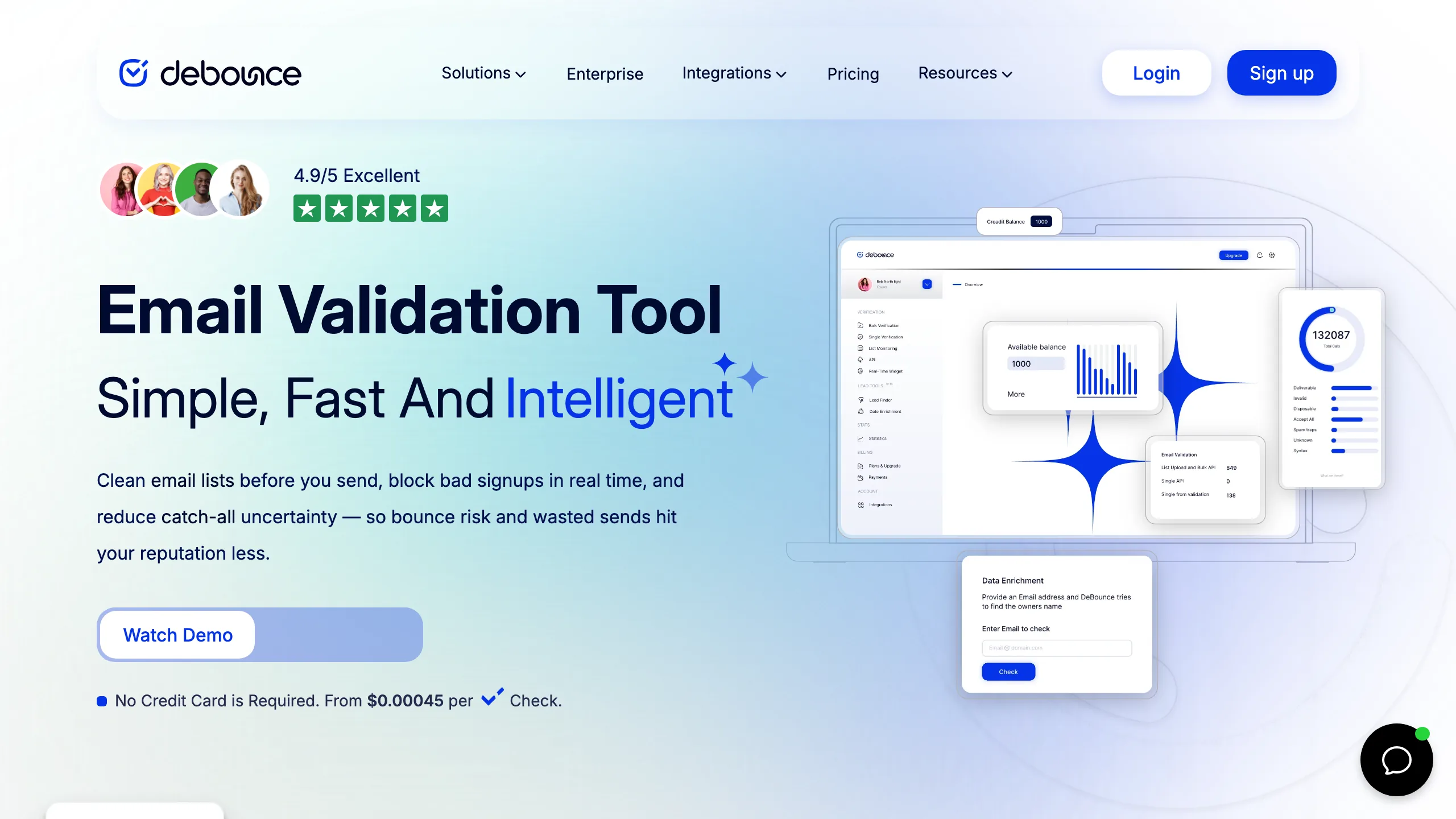
There is no tier table, only a slider: choose a volume between 5,000 and 5,000,000 and it quotes. The advertised floor is $0.00045 a check, the lowest of any dedicated verifier here, though reaching it needs serious volume and the page will not show the intermediate steps without a number. Credits never expire and deduplication is free. The line that matters most sits in the credit schedule rather than the pricing: a catch-all check costs 10 credits rather than 1, and enrichment costs 20.
Key features
- checkVolume slider, 5K to 5M no published tier table, you enter a volume.
- checkCredits never expire no monthly commitment, no setup cost.
- checkFree deduplication duplicates removed before consuming credits.
- checkCatch-all costs 10 credits the single most important number for a messy list.
Pros
- addLowest advertised floor rate here
- addCredits never expire
- addDeduplication at no charge
Cons
- removeCatch-all checks cost 10 credits each
- removeNo published tier table to compare
- removeNot in our verified review data
The honest read
Potentially the cheapest dedicated verifier and the hardest to price without entering your volume. On a catch-all-heavy list the 10-credit charge can undo the headline advantage entirely.
Hunter
Verification beside a finder
Verification is a separate product from search here, bought through the Data Platform at $11 for 1,000, $690 for 150,000 and $2,800 for a million. That is roughly $4.60 per 1,000 at the middle tier, well above the dedicated verifiers, and the trade is having finding, verifying and campaigns behind one familiar account with the best documentation in the category. Independent testing has put the verifier nearer 70 percent than its published 91 percent claim, which is worth weighing against the 634 G2 reviews at 4.4.
Key features
- checkVerification credits sold separately from search credits, via the Data Platform.
- checkFinder, verifier and campaigns one vendor, one login, one invoice.
- checkBest documentation in the category client libraries in most languages.
- check634 G2 reviews at 4.4 deep, long-standing feedback.
Pros
- addOne account for finding and verifying
- addDocumentation and support depth
- addLarge verified review base
Cons
- removeAround $4.60 per 1,000, above dedicated verifiers
- removeVerification billed apart from search
- removeIndependent tests below the published claim
The honest read
You are paying for the ecosystem rather than the verification itself. Sensible if you already run Hunter, poor value if list cleaning is all you need.
NeverBounce
Established, pricing not published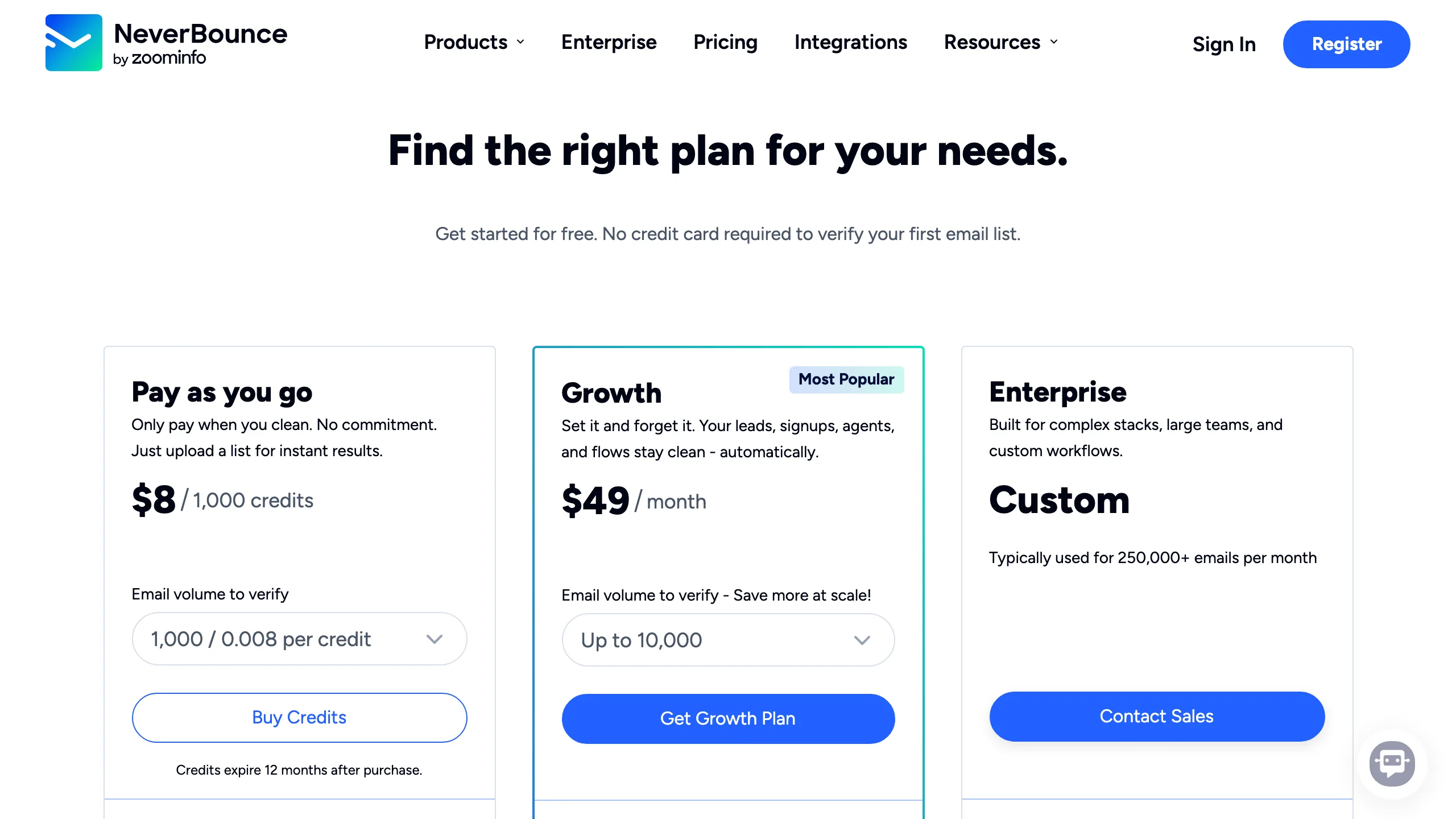
Long-established, ZoomInfo-owned, and on most shortlists in this category, with real-time verification, bulk list cleaning and a well-regarded API. It is included here for completeness rather than comparison, because every attempt to read its pricing page in September 2026 returned an HTTP 403 to non-browser clients, so no figure could be verified and none is quoted. If you are evaluating it, open the pricing page in a browser and hold the quote against the verified rates in the table above.
Key features
- checkReal-time and bulk verification the standard feature set, well executed.
- checkPart of the ZoomInfo platform rather than a standalone product.
- checkPricing behind a calculator no public table a client can read.
- checkEstablished product long history and wide recognition.
Pros
- addLong-established with a wide install base
- addReal-time API and bulk cleaning
- addBacked by a larger data platform
Cons
- removePricing page unreadable to non-browser clients
- removeNo figure verifiable for this comparison
- removeNot in our verified review data
The honest read
We will not quote a price we could not read. Get the quote yourself and compare it against the verified numbers above before committing.
Which one fits your situation
Choose by the problem you are actually solving.
| If this is you | Start here |
|---|---|
| You clean a large list a few times a year | MillionVerifier or EmailListVerify. Both sell credits outright at low unit cost, and neither puts a clock on them. |
| A lot of your list sits on catch-all domains | Bouncer does not bill for unknown results, and Mailsfinder reports catch-all as its own status rather than guessing either way. |
| You need verification inside a signup form or product | Mailsfinder from the Growth plan, Emailable and Clearout all expose a real-time API for inline checks. |
| Your sending domain reputation is the priority | ZeroBounce and Kickbox add inbox placement testing and deliverability scoring on top of verification, which is what you are paying the premium for. |
| You want to test properly before paying | Reoon gives 600 credits a month with API access included, the most usable free tier in the category. |
| You also need to find the addresses | Mailsfinder and Hunter do both from one account. Every dedicated verifier here means running a second vendor for the finding half. |
Five mistakes that survive a clean verification report
A list can pass verification and still bounce. These are the usual reasons.
Treating catch-all as valid
On a catch-all domain the server accepts everything, so a pass means nothing about the mailbox. Folding those into your main send is the most common cause of a list that verified at 98 percent and bounced at 8.
Verifying once and reusing the list for months
B2B addresses decay at roughly a quarter a year as people change jobs. A list verified in January is meaningfully wrong by June, whichever tool cleaned it.
Comparing published accuracy claims
Every vendor here claims 97 to 99 percent, measured on their own sample. The claims are not comparable. Run 500 of your own addresses through two free tiers and compare the disagreements, which takes an hour and tells you more than any page of marketing.
Assuming verification fixes deliverability
A clean list stops bounces. It does nothing about authentication, domain reputation, warmup or content. Teams often verify, see no improvement in inbox placement, and blame the verifier for a problem it was never solving.
Ignoring role and disposable addresses
info@, sales@ and support@ are usually deliverable and usually useless, and most tools flag them separately rather than as invalid. Decide your policy before the send rather than discovering it in the reply rate.
Category picks
Clearest handling of ambiguity
Mailsfinder reports catch-all as its own status, runs a live SMTP check, and draws verification and finding from one balance.
Fairest billing
Bouncer does not charge for unknown results or duplicates, and its credits never expire.
Best free tier for testing
Reoon gives 600 credits a month with API access, and holds the highest verified rating here at 4.8 across 1,018 reviews.
Deliverability tooling
ZeroBounce adds inbox placement, blacklist and DMARC monitoring, with 1,361 G2 reviews behind it.
Bulk list cleaning
MillionVerifier is built for large files and prices accordingly, with a daily-throughput plan from $15 a month.
Most predictable results
Kickbox returns a Sendex deliverability score with every check and has a reputation for conservative verdicts.
What you actually pay
Cost per 1,000 checks alongside what each free tier gives you. For the full tier-by-tier breakdown, including large-volume rates, see the verification pricing comparison linked at the foot of this page.
| Tool | Free plan | Entry price | What the entry price buys | Cost per 1,000, best plan |
|---|---|---|---|---|
| Mailsfinder | 100 credits a day, no API | $9.99/mo Starter | 75,000 credits a month | ~$0.1 |
| ZeroBounce | 100 credits a month | $39 pay as you go | 2,000 credits | ~$19.50 |
| Reoon | 600 credits a month, API included | $11.90 one-time | 10,000 credits, never expire | ~$1.19 |
| MillionVerifier | Trial credits on signup | $39 one-time | 10,000 credits | ~$1.78 |
| Bouncer | 100 credits, no card | $8 one-time | 1,000 credits minimum | ~$4.00 |
| Kickbox | 100 verifications free | $5 one-time | 500 verifications | ~$8.00 |
| Emailable | 250 credits on signup | $38 pay as you go | 5,000 credits | ~$4.90 |
| Clearout | 100 credits for life | $19.50/mo Starter | 3,000 credits a month | ~$6.50 |
| EmailListVerify | 100 credits on signup | $5 one-time | 1,000 credits | ~$1.86 |
| DeBounce | 100 credits, no card | Volume-quoted | 5K to 5M credit bands | ~$0.45 |
| Hunter | 50 credits a month | $11 one-time | 1,000 verification credits | ~$4.60 |
| NeverBounce | Not verifiable | Not published | Not published | n/a |